 |
| Wild White Bean Salad |
Last week I was shopping at a local health food store that has a nice selection of healthy salads in their delicatessen. After having a sample, I ordered a wild rice salad that they called Wild White Bean Salad. It had giant white beans in it that were at least an inch and a half across; I have never seen a bean this large before.
I chose to purchase the smallest container that they had available, the employee weighed it out and gave it to me; I tossed it in my cart without looking at the price.
I chose to purchase the smallest container that they had available, the employee weighed it out and gave it to me; I tossed it in my cart without looking at the price.
When I got home I couldn't believe how much I had paid for it, $4.20 for 0.42 lb or $9.99 a lb., which amounted to about 1/2 cup of salad.

At least it was good and my reason for buying it was so that I could figure out how to make it. The ingredients were listed on the label which made that part easy, I just had to play around with the vinaigrette to get the flavors right. I didn't 't have any large white beans so I used cannellini beans.***
Here is what I came up with:
Wild White Bean Salad
Here is what I came up with:
Wild White Bean Salad
- 1 cup Red Bell Pepper, diced
- 3/4 cup Celery, diced
- 3 tablespoons Fresh Parsley, chopped
- 1 cup Cannellini beans (160 gr) rinsed and drained
- 3 cups cooked Wild Rice (490 gr cooked)**
Combine above ingredients together and toss with vinaigrette (recipe follows). Refrigerate for several hours to allow the flavors to meld and the rice to absorb the vinaigrette.
** 1 cup dry makes approximately 3 cups cooked wild rice.
Vinaigrette
** 1 cup dry makes approximately 3 cups cooked wild rice.
Vinaigrette
- 2 teaspoons Dijon Mustard
- 3 tablespoons Honey
- 2 tablespoons Extra Virgin Olive Oil
- 4 tablespoons Good Balsamic Vinegar
- 1/4 teaspoon Sea Salt
- Pepper to taste
Blend together until emulsified using a small whisk or fork.
Recipe makes 5.2 servings or 1 cup each. This is a very generous serving but very low in calories and high in nutrition. you could easily serve 1/2 cup on a bed of spinach or arugula for a nice spring salad. Toss a little olive oil and balsamic vinegar on the greens then top with the bean salad.
Recipe makes 5.2 servings or 1 cup each. This is a very generous serving but very low in calories and high in nutrition. you could easily serve 1/2 cup on a bed of spinach or arugula for a nice spring salad. Toss a little olive oil and balsamic vinegar on the greens then top with the bean salad.
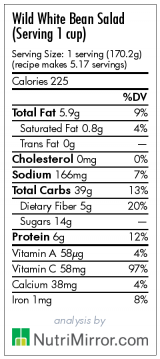
Nutritional Data provided by NutriMirror
Wild Rice, Minnesota's State Grain, is almost as old as history itself. This highly nutritious grain is not actually rice, but an annual water-grass seed, "zizania aquatica". Found mostly in the upper freshwater lakes of Canada, Michigan, Wisconsin, and Minnesota.
Wild rice towers over other rices when it comes to amounts of protein, minerals, B vitamins, folic acid, and carbohydrates. While the protein content of 1/2 cup of cooked wild rice measures 3.3 grams, that same quantity of long grain brown rice contains only 2 grams. The bonus is that the wild rice, though high in carbohydrates at 17.5 grams, has only 83 calories for 1/2 cup cooked.
Using the same 1/2 cup measurement of cooked rice grains, the folic acid content soars over brown rice with 21.3 mcg for wild rice and 3.9 mcg for brown rice. According to the University of California Berkeley Wellness Encyclopedia of Food and Nutrition, 1/2 cup dry wild rice provides 95 mcg or 48% of the RDA (200 mcg) of folic acid for men and 53% for women.
***Since making this I have had a few people tell me that the bean may be a large Lima Bean called Gigandes beans. Leave it to the Peruvian's to find us yet another wonderful bean! Sounds like I need to head to my local Vallarta Supermarket and find these beans!


